
NMCD Release Record Scope
NMCD is the New Mexico Corrections Department. It runs the state prison system, Offender Management Services, and the statewide Probation and Parole Division. Its offender data can connect a prison placement with later community supervision or an inactive record. NMCD does not control county or city detention facilities. A person jailed locally and released on bond without entering state custody may never appear in the NMCD offender search.
The agency’s official home page identifies NMCD and routes to its divisions and search tools.

The agency role matters because county release, state-prison exit, and final sentence discharge create different records.
A county notation such as “released to DOC” means the local jail’s custody ended while state confinement began. An NMCD institution location means the person has not been proved physically released. A P&P location can mean the person left prison but remains supervised. Inactive status may reflect a former record, but it does not by itself establish successful discharge.
Use NMCD Offender Search
Begin at the NMCD offender search wrapper. It states the jurisdiction and current warnings before linking to the interactive application. Search by first and last name, or use the offender number when known. The official form also provides age limits, four region filters, and status controls.
- Read the wrapper’s current warning and follow its link to the interactive search.
- Enter the last and first name, or use the NMCD offender number for a more exact match.
- Select Include Inactive when looking for a former prisoner or former supervisee.
- Use age and identity details to separate namesakes before opening a result.
- Read the exact location, offense, and supervision words shown. Do not add a status the profile does not display.
- Verify recent movement with the institution, P&P office, or source record.
The interactive NMCD offender search displays the search fields and Active, Include Inactive, and Absconder Only controls.
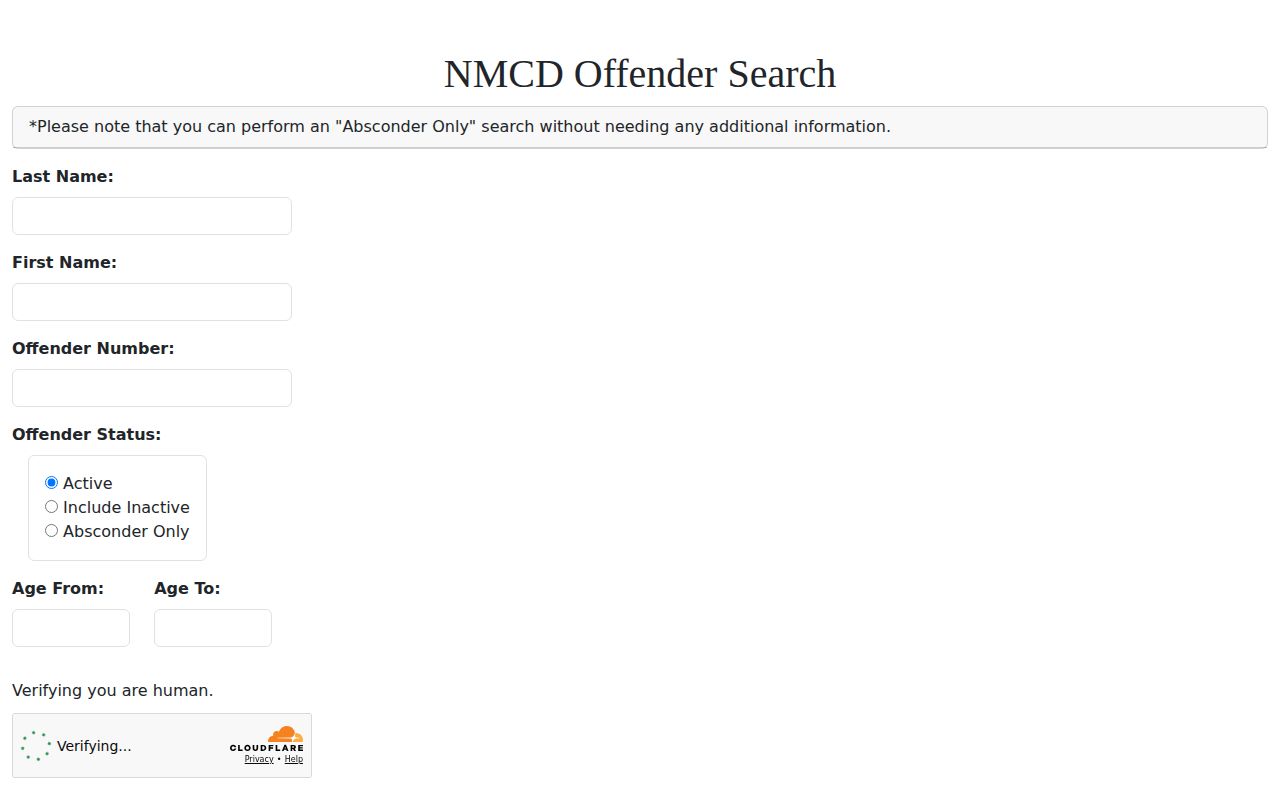
Include Inactive is essential for NMCD released inmates research, while Absconder Only serves a narrow supervision inquiry and is not a prison-release filter.
NMCD Search Absence Limits
The public search contains an unusually important warning. A person who once appeared but no longer does may be missing because of technical trouble, and disappearance does not establish release or the end of supervision. A spelling mismatch, a county-only custody history, an access restriction, or an expungement effect can also explain an empty result.
Adult Prisons information is updated nightly, with up to 24 hours allowed for availability. Probation and Parole data is described as updating in real time. Neither pace turns a portal into a live gate log. Very recent movement should be checked with the office that held or supervises the person.
The NMCD jurisdiction and cadence notice puts those limits next to the search route.
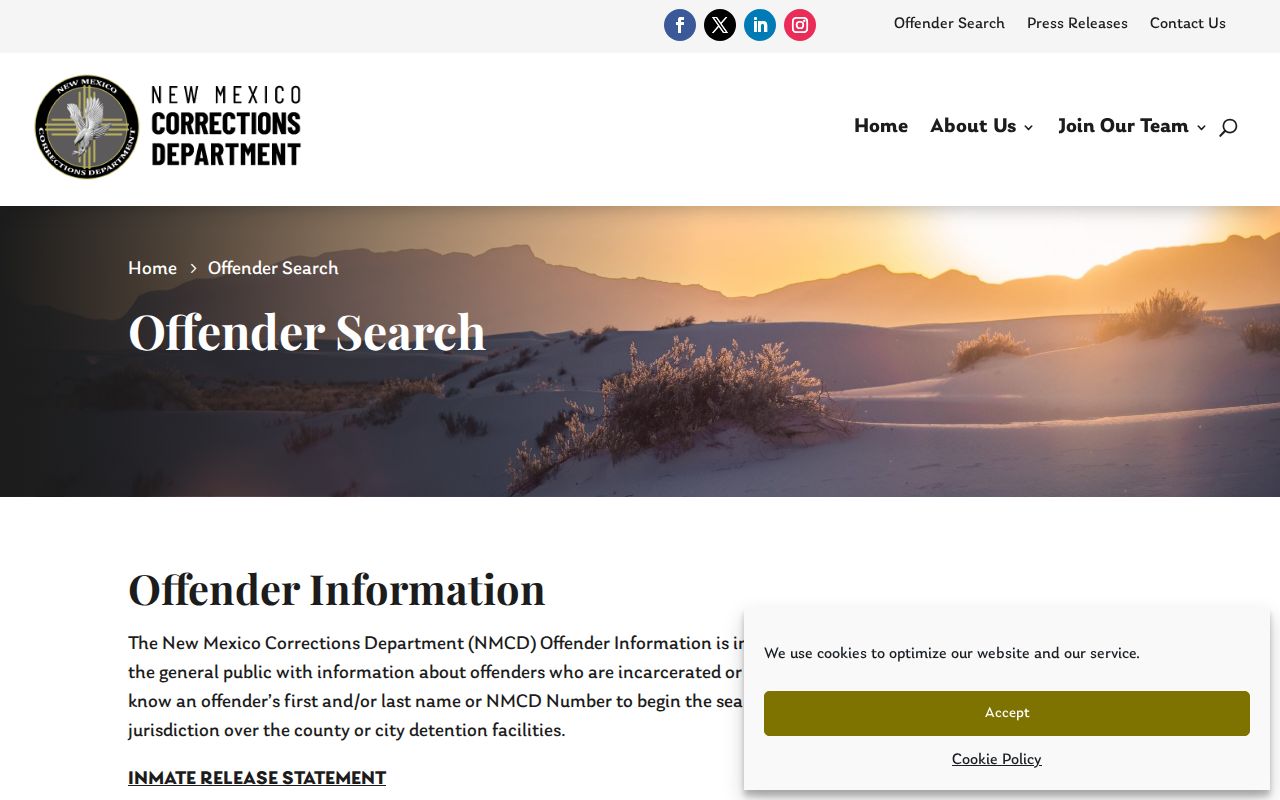
This warning is why an absent NMCD record must never be rewritten as a confirmed discharge.
Important: Record only what the live result shows, then request the movement or discharge document for any fact the profile omits.
Read NMCD Released Records
NMCD’s official description supports public location, offense, and supervision information. It does not promise that every former person has a universal Released, Discharged, or Inactive label, nor does it guarantee an actual release date on every public profile. The Include Inactive control proves that inactive records can be queried, not that each completed case remains online forever.
| Public clue | Careful reading |
|---|---|
| Offender number | Identifies the NMCD record more safely than a common name |
| Institution location | Shows a prison association and does not prove physical release |
| P&P location or status | May show community supervision after prison exit |
| Inactive result | Shows the record is returned through the inactive search, not why the case ended |
| Offense information | Helps match identity and sentence context but is not a release record |
| No result | Is inconclusive under NMCD’s own warning |
When the exact prison-exit date, release type, Projected Release Date, or final discharge is absent, obtain the underlying agency document. Public search language should never be expanded beyond the field that appears.
NMCD Release and Discharge
New Mexico law creates several points that can sound alike. Parole is release to the community from an institution by Board decision or operation of law, under conditions and supervision. Most modern determinate sentences move to parole when the incarceration portion has been served, while life cases involve a discretionary hearing after the applicable eligibility period. Eligibility or sentence completion still does not prove a gate exit.
NMCD policy uses “in-house parole” for a person serving parole while still inside because an acceptable plan has not led to physical release. Once a plan is approved, movement may occur, but the institutional release record remains the proof. Final discharge comes later. After successful parole completion, Section 31-21-10 requires a final Board order and certificate of discharge.
- Prison release
- The documented physical exit from an NMCD institution.
- In-house parole
- Parole status while the person remains inside pending an approved plan.
- Supervision
- Conditions monitored by P&P after a community release.
- Final discharge
- The formal end record, distinct from the earlier prison exit.
NMCD Projected Release Calculations
NMCD calls its working date the Projected Release Date, or PRD. Offender Management Services begins with the judgment and sentence, accounts for presentence confinement credit, applies statutory earned meritorious deductions, and posts awarded or forfeited credit. Policy forms CD-080400.5 and CD-080400.6 record the PRD, Current PRD, New Updated PRD, and reasons for change.
Current Section 33-2-34 and NMCD policy provide maximum deductions of four days per month for a serious violent offense and 30 days per month for another eligible offense. Awards can be forfeited, restored where authorized, or supplemented by qualifying lump awards. Amended judgments and corrected presentence credit can shift the baseline. Life sentences sit outside this ordinary PRD credit calculation.
The Offender Management Services page explains the unit’s sentence and release-calculation responsibility.

OMS records, rather than a homemade percentage, are the correct source for a person’s calculation.
New Mexico is not accurately reduced to a universal 85-percent rule. The actual statutory rates, offense class, judgment dates, credit history, and current NMCD calculation control. A PRD is still a projection, not a promised release appointment.
NMCD Release Date Changes
Form CD-080400.6 names several reasons for revising a Projected Release Date: a low evaluation, forfeiture, a lump-sum award, revocation of an earlier award, an amended judgment, or another documented reason. Restoration can move a date earlier, while lost credit can move it later. A corrected presentence-confinement total or amended judgment changes the base before deductions are applied. Consecutive sentences add another layer to the calculation.
A correct arithmetic date still may not be the day of community release. A detainer can transfer custody to another agency. A pending court order may change the legal path. A parole-plan problem can produce in-house parole even after the basic prison term ends. These are reasons to separate the PRD from the actual movement record and the later supervision record.
The best verification order is to compare the judgment and every amended judgment, obtain the latest OMS calculation, identify whether the date is parole eligibility, PRD, or full term, and then confirm movement on or after that date. If parole follows, its start and completion require separate proof.
NMCD Prison Release Sources
NMCD’s current prison directory lists Central New Mexico Correctional Facility, Guadalupe County Correctional Facility, Northeast New Mexico Correctional Facility, Penitentiary of New Mexico, Roswell Correctional Center, Springer Correctional Center, Southern New Mexico Correctional Facility, Western New Mexico Correctional Facility, and privately operated Otero County Prison Facility. Classification and operational needs can place a sentenced person at an institution far from the county of conviction.
A releasing institution may supply movement confirmation, while OMS maintains sentence calculation and central record functions. The facility that appears last should be checked when movement is fresh. Statewide New Mexico facility directory links each prison to the verified county destination and keeps state prisons separate from county, tribal, and ICE custody.
Note: A transfer between two NMCD institutions changes location but does not establish release to the community.
NMCD Gate Money Evidence
NMCD policy CD-024500 recognizes gate money in the release process. The reviewed public material does not establish one universal amount or one identical release-day package. An institution, trust-account balance, approved destination, and current local procedure can affect what happens. Statewide copy should not promise cash, clothes, transport, an exit door, or a release hour that the source does not support.
The policy’s treatment of gate-money return when release does not occur reveals the key distinction. Account preparation may show that staff expected a planned release. It cannot prove that the person crossed the gate. The institutional movement/release history remains the authoritative physical-exit record.
That difference is especially important when a PRD passes but a plan, detainer, court matter, or other condition changes the outcome. Supporting documents should be read as parts of the event, not substitutes for the final movement entry.
NMCD Release Trend Boundaries
NMCD’s FY2024 report states that the calendar-year 2024 average daily prison population was 5,285 and that P&P served more than 13,000 people. The 2025 annual report, published in April 2026, says Adult Prisons operated eight public facilities and contracted for part of Otero County Prison Facility. It describes capacity and a current population above 5,800, while P&P supervises about 13,200 people each year.
None of those figures is a statewide annual actual-release total. They measure prison stock, capacity, or the population served by supervision. The Sentencing Commission’s count of 5,672 people confined on June 30, 2025 and projection of 877 basic-sentence cases into release year 2026 also do not prove 877 exits. Its separate sample of 325 male EMD release records is a study sample with exclusions.
The NMCD reports archive keeps the reporting periods visible. Any trend statement must retain its date, denominator, and source. Population counts cannot be relabeled as releases just because they are recent or statewide.
NMCD Versus County Release
NMCD and county jails cover different custody histories. A local jail records bond, recognizance, time-served, dismissal-related, locally sentenced, and transfer exits. NMCD records the prison and statewide supervision side after a state commitment. A county may release someone to NMCD, which ends county custody but begins or continues state confinement.
| Question | NMCD | County jail |
|---|---|---|
| Who is covered? | State prisoners and statewide P&P records | People held by that local facility |
| What proves exit? | Institutional movement/release history | Booking and release history |
| What may follow? | Parole, P&P, or final discharge | Court case, transfer, or separate supervision |
| Where to request? | NMCD custodian and NextRequest | Holding jail’s records custodian |
The New Mexico County Directory routes a county-only episode to the locality that held the person. Searching NMCD alone can miss a release that never entered state jurisdiction.
Request NMCD Release Records
For a status question, NMCD lists Inmate Records at 505-690-9790 and statewide P&P at 866-416-9867. Victim Services publishes 877-842-8464 for eligible inquiries about supervision status, location, and release date, Monday through Friday from 8:00 a.m. to 5:00 p.m. Mountain Time. The search page says Central Office, Constituent Services, and the Records Bureau cannot provide release updates, so urgent status inquiries should not be sent indiscriminately.
For documentary proof, submit through NMCD NextRequest or use the custodian on the department’s IPRA page. Include the full name, NMCD number, approximate institution, and narrow date range. Ask for existing movement/release history, release authorization, sentence calculation, latest PRD record, Forms CD-080400.5 and .6, parole orders, or a certificate of discharge as relevant.
- State the exact record sought and the custody event it should document.
- Request an electronic copy and permit lawful redaction.
- Track the IPRA response, including the three-business-day timing notice when production is not immediate.
- Use the institution or P&P office for fresh movement, and the Board for its orders.
IPRA generally contemplates production within 15 calendar days unless a broad or burdensome request requires a communicated reasonable extension. NMCD need not create a new narrative or legal calculation. Precise document names make the response more useful and reduce the risk of mistaking a public-search clue for the final record.
NMCD Discharge Proof Chain
No single public field answers every meaning of “released.” The institutional movement record answers when NMCD physical custody ended. The OMS calculation explains the sentence and credit record behind that event. A P&P record identifies community supervision. A New Mexico Parole Board final order and certificate answer whether parole obligations ended. The court docket can supply the judgment or amended order that changed the calculation.
This proof chain also prevents two opposite errors. A person on in-house parole should not be described as physically released merely because the prison term reached a parole point. A person living in the community under P&P should not be described as finally discharged merely because the institution no longer appears as the location. The record should use the narrow status each source supports.
A release inquiry may therefore end with more than one valid date. The PRD shows an agency calculation at a point in time. The movement entry shows the institution exit. The supervision start marks the next legal phase, and the certificate records its end. Keeping those dates labeled prevents a later researcher from treating one milestone as the whole custody history.
For an old or missing public result, request the records in sequence instead of relying on a screenshot or a vanished listing. That approach preserves dates, authority, and the distinction between release, transfer, supervision, and discharge.