
New Mexico Release Date Clocks
One date cannot answer every release question. NMCD uses Projected Release Date, or PRD, for its working prison calculation. A parole eligibility date marks when a qualifying case may be considered or when a sentence reaches a parole point. The full-term date marks the sentence boundary before other lawful adjustments. An actual release date records physical departure from an institution. Final discharge comes later if parole or probation must still be completed.
County custody follows a different clock. A pretrial detainee usually has no fixed release date because bond, a court order, dismissal, a hold, or case resolution can change the outcome. A locally sentenced person may have a jail calculation, but NMCD does not control it. The county jail record supplies the actual exit time and release code. A transfer to NMCD, the U.S. Marshals Service, or ICE is an exit from one jail, yet custody continues elsewhere.
The New Mexico Corrections Department home page identifies the statewide prison agency and its offender-search entry.

That agency route applies to NMCD prisoners and supervisees, not to people whose custody history stayed entirely in a county jail.
Find a New Mexico PRD
Begin with the official NMCD search, but treat it as a discovery tool. The form supports first and last name, offender number, age range, status choices, and Probation and Parole regions. An offender number is safer than a common name. Select Include Inactive when looking for a former prisoner or supervisee. An Active-only query can omit the very record needed.
The NMCD interactive offender search shows the available search controls.
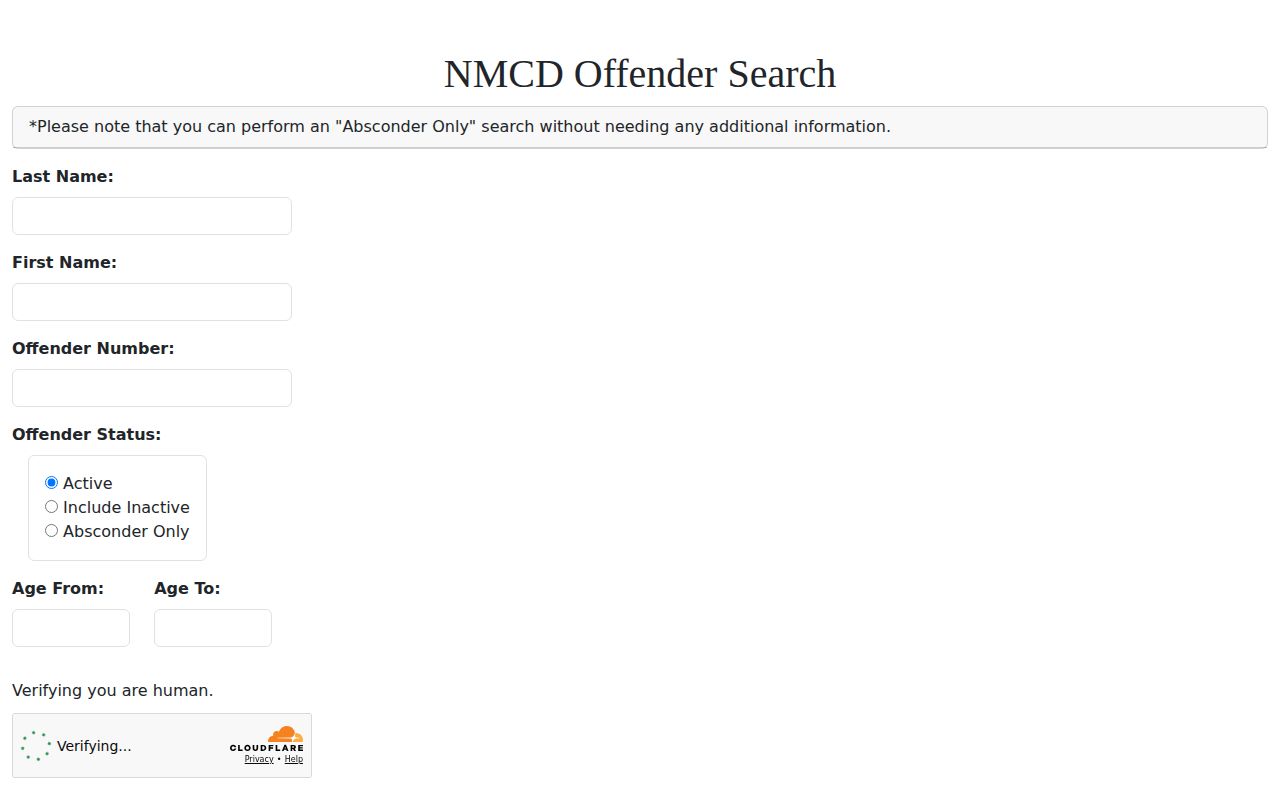
Its status filters help find a record, but they do not guarantee a public PRD field or prove that an absent person was released.
- Open the official NMCD offender-search wrapper, read its current warning, and continue to the interactive form.
- Enter the last and first name. Add the offender number when known, then compare age and other shown facts.
- Select Include Inactive for a former prisoner or former supervisee. Do not treat Absconder Only as a release filter.
- Open the matching record and identify whether it shows an institution, a P&P location, or another status.
- If no PRD appears, contact Inmate Records or request the latest sentence calculation and PRD change forms.
For a person serving only a local jail sentence, use the County Directory to identify the actual holding jail and its records process. Ask that jail for the booking and release history. Court Case Lookup can help identify a sentence or amended judgment, but a docket summary does not supply the jail-door time.
Note: Adult Prisons data updates nightly and may take up to 24 hours to appear, so recent movement needs direct verification.
New Mexico Earned Deductions
New Mexico calls its prison credits earned meritorious deductions, or EMD. Under NMSA 1978 §33-2-34, as amended by 2025 Senate Bill 375 and implemented by NMCD policy revised in 2026, eligible credits reduce the remainder of the sentence after presentence confinement credit is applied. The offense class matters. So do conduct, required participation, work duties, and the rules in force for the judgment and offense dates.
| Sentence category | Maximum statutory EMD rate | Important limit |
|---|---|---|
| Serious violent offense | 4 days per month | The actual statute and NMCD classification control. |
| Other eligible offense | 30 days per month | Eligibility and continued retention still depend on law and policy. |
| Life sentence | Not part of the ordinary PRD credit calculation | Eligibility and Board rules follow a different track. |
This framework rejects a universal 85-percent claim. In a simplified 30-day example, four credit days advance 34 sentence days for 30 days served, or about 88.2 percent served. That illustration is not a personal calculation. Month length, consecutive terms, presentence credit, amended judgments, forfeiture, restoration, and offense classification all affect the official result.
NMCD policy allows credits to be lost or revoked. It also permits restoration when authorized after a period of exemplary conduct, as well as lump-sum awards in qualifying situations. A return after parole revocation uses deductions tied to the underlying offense classification. These moving parts are why an old estimate should never be carried forward as though it were current.
The final text of Senate Bill 375 documents the enacted EMD framework.
The official NMCD offender-search page supplies the public search limits and movement-verification warning.
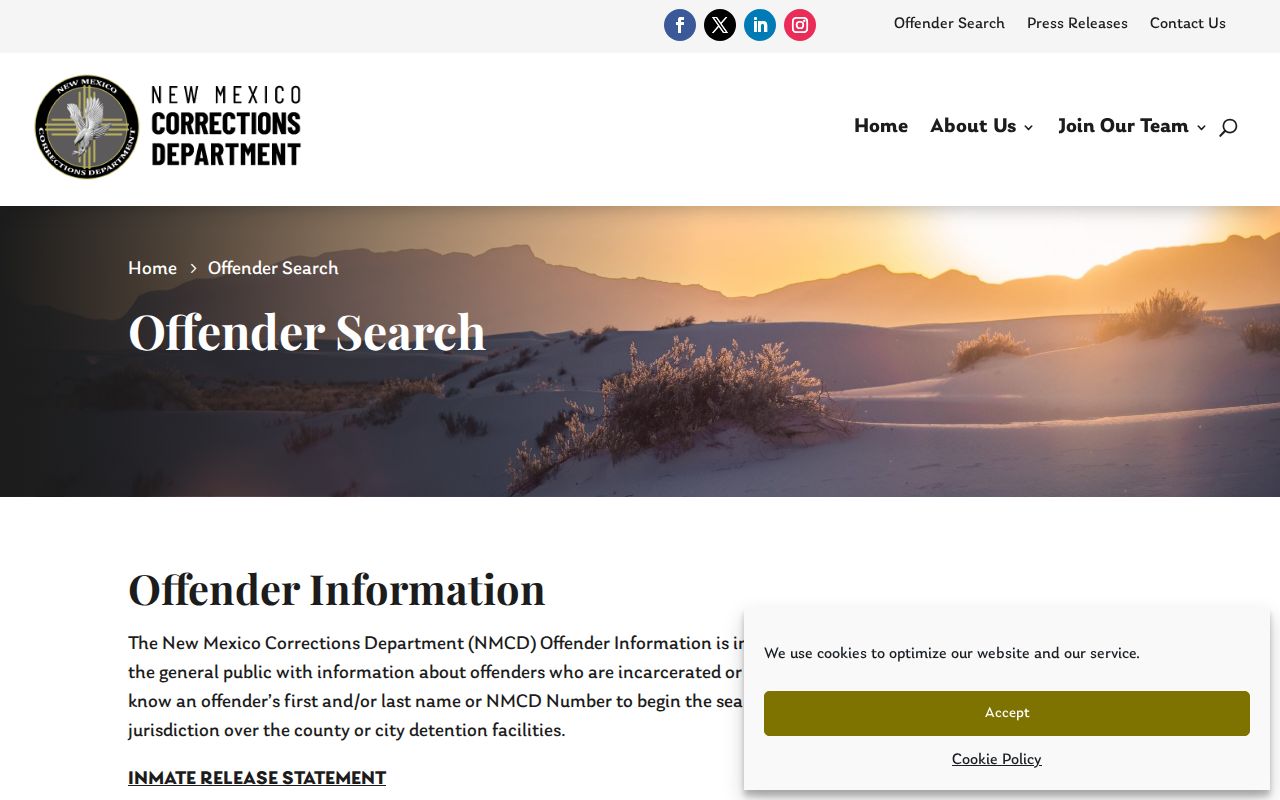
The official search warning reinforces the key rule: a public listing or its absence cannot replace the agency calculation and release record.
Why New Mexico Rejects 85%
New Mexico’s actual statutory rates are more useful than a slogan. Four days per month applies to serious violent offenses, while 30 days per month applies to other eligible offenses. Neither rate can be converted into one sound percentage for all prisoners. The current NMCD forms also distinguish a Current PRD from a New Updated PRD, making the estimate’s provisional nature plain.
Forms CD-080400.5 and CD-080400.6 record the inmate name and number, the deduction category, days awarded, the working PRD, and changes to that date. Those internal records are stronger evidence than a hand calculation. A person seeking the exact basis should request the latest form, the certified case summary, and the judgment used by Offender Management Services.
- PRD
- NMCD’s working Projected Release Date based on the sentence calculation then in effect.
- Parole eligibility
- The point when parole consideration or a statutory parole stage may begin, not proof of release.
- Full term
- The sentence endpoint tracked apart from the working PRD and eligibility date.
- Discharge
- The later legal end of parole or probation, documented by the authorized agency or court.
Note: No public NMCD documentation promises that every offender-search result will display the internal Projected Release Date.
New Mexico PRD Changes
Form CD-080400.6 lists several reasons for a new date. Some alter the arithmetic. Others affect what happens at the gate even if the calculation stays the same. A detainer is a request or authority to hold or transfer someone for another agency. It can prevent community release without erasing the first agency’s sentence calculation.
| Event | Effect on the date or exit |
|---|---|
| Low evaluation or forfeiture | Loss of EMD can move the PRD later. |
| Restored or lump-sum EMD | Authorized credit can move the PRD earlier. |
| Revocation of awarded EMD | Previously posted credit is removed and the date is recalculated. |
| Amended judgment | The legal sentence or presentence-credit baseline changes. |
| Consecutive sentence or pending matter | Another term or court case can block the expected exit. |
| Detainer or hold | The person may transfer to another authority instead of entering the community. |
| Parole-plan problem | A person can remain in-house after the basic term until an acceptable plan is approved. |
The Offender Management Services and Classification page identifies the unit that reviews judgments, calculates release dates, and posts earned or forfeited credit.

That office function explains why the latest OMS calculation, rather than an informal estimate, is the sound source for a New Mexico inmate release date.
New Mexico Court Release Dates
A judgment sets the legal base that OMS must calculate. Presentence confinement credit accounts for qualifying time already spent in custody before admission. If the court later files an amended judgment, the term, credit, or sentence structure can change. New Mexico Case Lookup may reveal the judgment, sentence, later hearings, and an amended entry. The online summary is not the official court record, though. Obtain the operative order from the clerk when the calculation depends on its exact terms.
A court date also should not be mistaken for a release date. A dismissal, acquittal, bond order, or sentence may explain why a jail can release someone, but the local jail record shows whether and when the exit occurred. A commitment order can instead explain a transfer into NMCD. For a state prisoner, OMS then reviews the judgment and sentence, applies presentence credit, posts lawful deductions, and maintains the projected date. Each record answers a separate part of the sequence.
County sentences remain local unless the person enters state custody. Ask the jail for the booking and release history, actual timestamp, coded disposition, releasing authority, active holds, and destination. If the jail reports release to another agency, continue the search there. This prevents a transfer from being mislabeled as release to the community and keeps the New Mexico inmate release date tied to the authority that held the person.
Confirm New Mexico Prison Release
Verification follows the custody chain. Compare the original judgment with any amended judgment. Obtain the latest OMS sentence calculation. Determine whether the date is parole eligibility, PRD, or full term. Then verify the movement record on or after that date. If parole begins, track its start and later completion as separate events.
In-house parole needs special care. NMCD uses that term when the basic sentence has ended but the person remains inside because an acceptable parole plan has not led to physical release. A parole date in that case is not a gate exit. Once released to the community, the person may remain under P&P supervision. Successful completion is proved by the Board’s final discharge order and certificate, not by the earlier PRD.
For most modern determinate sentences, New Mexico describes parole as following once the incarceration part has been served, subject to written conditions and a workable plan. Life-sentence cases follow a different path and may require a Board hearing after the controlling eligibility period. Eligibility is only permission for consideration. A grant may still await conditions and plan approval. Medical or geriatric parole also follows its own provisions. None of these routes justifies turning the PRD into a promised date.
Release planning can affect the real-world outcome without changing every line of the arithmetic. NMCD’s Community Corrections program describes statewide transitional coordinators and structured programs as routes used in some cases. Those are navigation facts, not promises of admission. The controlling records remain the sentence calculation, any Board action, plan approval, and the movement entry. If the expected date passes with no confirmed exit, check those records before assuming an error.
When a public result lacks the date, NMCD lists Inmate Records at 505-690-9790. Eligible inquiries about supervision status, location, and release date may use Victim Services at 877-842-8464, Monday through Friday, 8:00 a.m. to 5:00 p.m. Mountain Time. The official search says Central Office, Constituent Services, and the Records Bureau cannot provide release updates, so urgent status calls should not be sent there.
For a documentary response, use NMCD NextRequest. Identify the full name, NMCD number, likely institution, date range, and existing records sought. Useful targets include movement history, release authorization, latest PRD form, certified case summary, parole order, and certificate of discharge. Ask for electronic records and allow lawful redaction rather than asking NMCD to create a new calculation.
New Mexico’s Inspection of Public Records Act supplies the records-request framework. The custodian generally permits inspection at once or as soon as practicable. If the records are not supplied within three business days, the custodian must give a written timing response. Production ordinarily follows within 15 calendar days unless an excessively broad or burdensome request requires a reasonable added period. The agency need not create a record or answer a legal question, which is why a request should name existing forms and movement entries.
Once a projected date arrives, keep its date and source with it. Later credit posting, an amended judgment, a detainer, or a plan issue may supersede that calculation. On the expected day, check the movement record rather than assuming the estimate became fact. If the person enters parole, verify the P&P start separately. The eventual certificate of discharge marks the end of parole, not the prison release date.